The Investigative Teardown: Unlocking the 2T Silicon Barrier
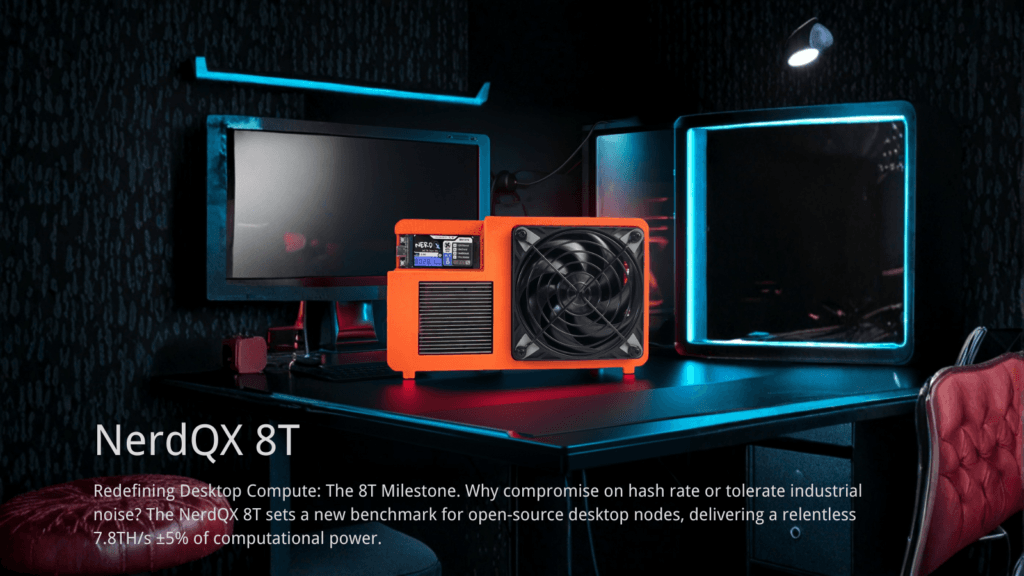
As an independent hardware lab, we look past the marketing spec sheets and examine the silicon reality. Both the NerdQX 8T and the NerdQaxe++ Rev6.1 share the identical core engine: 4x Bitmain BM1370 ASICs, the exact same 5nm silicon driving enterprise mining farms. So, how does one machine output 6.0 TH/s while the other pushes a massive 8.0 TH/s?
The answer lies in the physics of the “2T Silicon Barrier.”
In low-voltage desktop environments, the BM1370 is highly efficient up to about 1.5 TH/s per chip. At this level, the NerdQaxe++ 6T operates in the absolute efficiency sweet spot, delivering 6.0 TH/s at a mere 100W, translating to a remarkable ~16.7 J/TH. However, pushing a single BM1370 chip to 2.0 TH/s (to achieve the 8T total) forces the silicon across a non-linear voltage threshold. The power requirement doesn’t scale linearly; it spikes dramatically. To hit 8.0 TH/s, the NerdQX 8T must draw 170W (±10%).
This is the exact point where cheap, secondary-market clone boards melt. You cannot achieve 8T by simply flashing an aggressive AxeOS firmware update. It demands a complete bottom-up redesign of the Power Delivery (PD) network and the thermal dissipation logic. DigLucky’s engineering team did not just overclock the chip; they overbuilt the infrastructure to support it.
Commercial Reliability Spec Showdown
For B2B Procurement Managers, “paper hashrate” is irrelevant if the hardware burns out in 60 days. Distributor margins are destroyed by RMA (Return Merchandise Authorization) shipping costs and technical support tickets. Here is how the two architectures stack up from a supply chain risk perspective:
| Assessment Metrics | NerdQX 8T (High-Density Node) | NerdQaxe++ Rev6.1 (Desktop Node) | B2B Channel Impact & Risk Analysis |
| True Wall Power | 170W (±10%) | 100W | The 8T requires an industrial-grade 250W switching PSU (included) to eliminate voltage drops during peak continuous compute cycles. |
| I/O Interface | Gold-Plated XT60 | Heavy-Duty XT30 | XT60 terminals handle significantly higher amperage, eliminating the risk of connector melt-downs under the continuous 170W load. |
| Thermal Architecture | Copper Heat-Pipe + Reactive PWM | Custom Low-Profile Heatsink | Copper substrates prevent thermal throttling at 8T. Ensures 24/7 thermodynamic equilibrium and drastically reduces motherboard thermal stress. |
| Acoustics | Variable (Peaks at ~48 dBA) | Strictly < 45 dBA | The 6T is the ultimate silent bedroom miner. The 8T moves more air, making it better suited for dedicated edge-node environments. |
| RMA Risk Profile | Ultra-Low (<0.5%) | Low (<1.0%) | Industrial over-engineering on the 8T protects distributor brand equity and slashes post-sale technical support overhead. |
Industrial-Grade PCBA & Thermal Engineering
Let’s look at the PCB. The NerdQaxe++ Rev6.1 is a masterclass in compact engineering. It requires zero external host controllers and utilizes a built-in ESP32-S3 architecture, keeping downstream provisioning frictionless.
The NerdQX 8T takes this autonomous integration and reinforces it with armor. The power delivery phase on the 8T abandons standard DC barrel jacks entirely. Every wholesale unit is provisioned with a 250W Switching Power Supply that connects via a heavy-duty, gold-plated XT60 interface. For distributors, this guarantees maximum thermal conductivity and absolute zero voltage drops during peak loads.
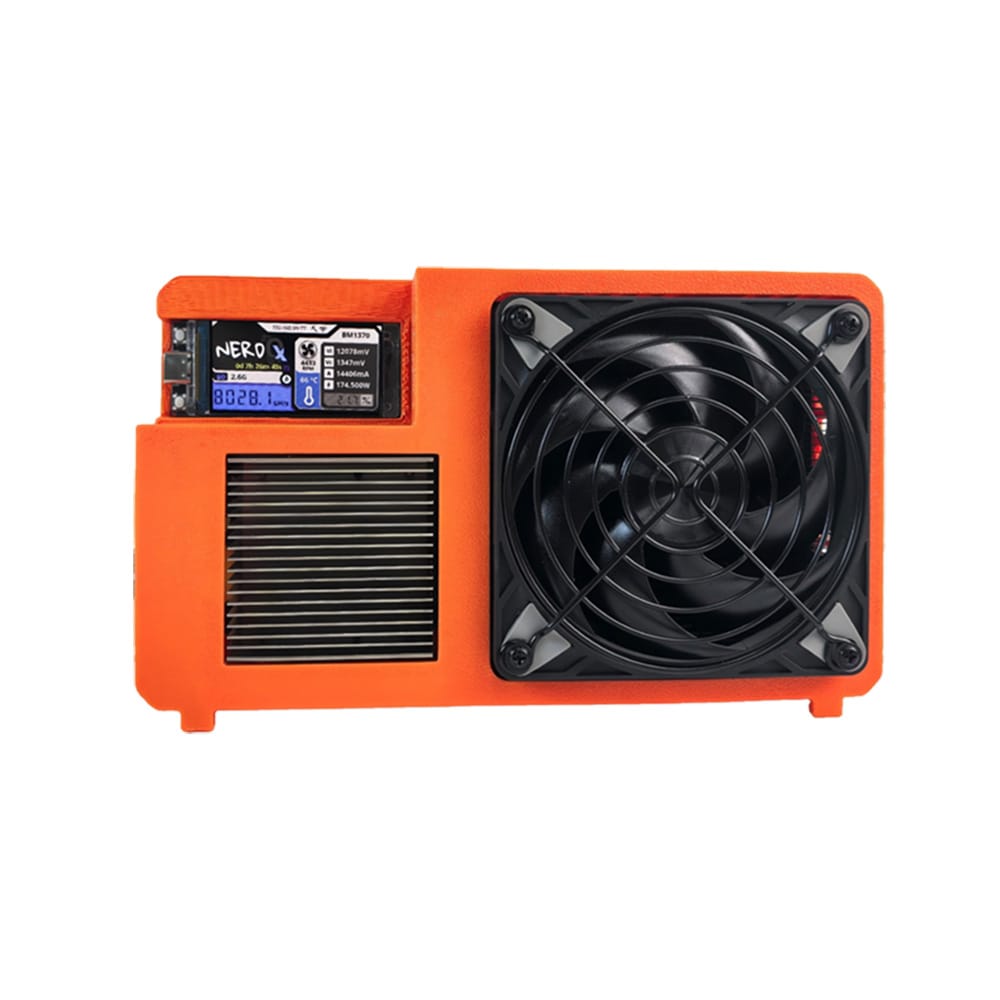
Furthermore, the NerdQX 8T deploys a custom copper heat-pipe dissipation substrate paired with a reactive PWM active-cooling network. When the BM1370 silicon telemetry detects a temperature spike, the fan speed self-calibrates in real-time. This prevents the performance degradation that plagues lesser machines, ensuring that the 8.0 TH/s (±5%) output is sustained, not just a theoretical peak.
Market Impact: Will the 6T Price Crash?
A common question from regional distributors is whether the release of the NerdQX 8T will cannibalize the NerdQaxe++ 6T market, forcing a price crash. The data from the “DigLucky Global Distributor Pricing Matrix 2026 Q2 Official Release” and historical market segmentation suggest otherwise.
These devices target fundamentally different consumer profiles. The NerdQaxe++ 6T (MSRP $369) dominates the “Silent Desktop” niche. It restricts ambient acoustic levels to strictly below 45dB, making it the ultimate living room or office conversation piece.
The NerdQX 8T is destined to become the next massive high-volume single SKU, but its target is the hardcore tech enthusiast, the edge-node deployer, and the decentralized network purist who prioritizes raw cryptographic throughput over absolute silence. The 8T does not kill the 6T; it complements it, allowing distributors to capture both the premium aesthetic market and the raw performance market.
The Honesty Tax: Building B2B Trust
We do not write pure marketing copy; we write engineering realities. To achieve a sustained 8.0 TH/s, there is an unavoidable trade-off: heat and noise.
The NerdQX 8T draws a stable ~170W. While the copper heat pipes manage the thermal load beautifully, the reactive PWM fan must spin faster to exhaust that heat. Under heavy load in warmer environments, this device will exceed the 45dB whisper-quiet threshold of its 6T sibling. Furthermore, its 250W enterprise PSU demands a stable, grounded electrical connection. This is an industrial machine shrunk to desktop size, and it behaves like one. We highly advise distributors to set proper acoustic expectations with their retail buyers to maintain high customer satisfaction.
The Evaluation-to-Scale Pivot
Both the NerdQX 8T and the NerdQaxe++ 6T feature autonomous node integration, utilizing integrated 2.4GHz wireless network modules and embedded web-based telemetry consoles. This eliminates the need for upstream controllers or Raspberry Pi overhead, ensuring rapid hardware provisioning.
While DigLucky allows the purchase of single units for independent lab evaluation and hardware tinkering, make no mistake: this PCBA architecture is designed exclusively for scale. It features strategic Stratum flexibility—universally compatible across SOLO, PPLNS, and PPS protocol allocation matrices.
Before any master carton is dispatched to a global distributor, every single unit undergoes a brutal 48-hour burn-in QC test at the Shenzhen manufacturing center. This factory-direct QA process is the ultimate safety net for B2B procurement managers, ensuring that you are sourcing reliable infrastructure, not unverified DIY kits.
CRITICAL DISCLAIMER: HARDWARE EVALUATION
These desktop ASIC devices operate in high-variance SOLO mining mode. While the current block reward is 3.125 BTC, the odds of a single unit discovering a block are minimal, and expected financial returns may be zero. DigLucky provides this hardware strictly for tech evaluation, open-source development, and education—not as a financial investment.
B2B Procurement & Technical FAQ
Q: Can the NerdQX 8T be scaled into a rack-mount or farm environment without burning out?
A: Yes. The transition to the XT60 connector and the inclusion of the 250W switching power supply specifically removes the bottlenecks associated with standard desktop miners. It provides a 30%+ power headroom, ensuring the VRMs do not overheat during 24/7 operations in higher ambient temperatures.
Q: If the NerdQX 8T is the performance king, why should a distributor still stock the NerdQaxe++ 6T?
A: Acoustic management and visual appeal. The 6T utilizes a vivid 1.9″ LILYGO Color LCD and operates under 45dB, making it the perfect consumer-grade educational gift or office gadget. The 8T is an uncompromised performance node. Stocking both allows you to capture the entire spectrum of the decentralized hardware market.
Q: Do we need to flash custom firmware to achieve the 8.0 TH/s output?
A: No. The hardware ships factory-tuned with stable, open-source firmware calibrated explicitly for this power delivery network. DigLucky’s engineering team has already recalibrated the voltage parameters for the BM1370 array in this specific chassis.
Start Your Project Today
Submit your requirements (even if they’re just an idea) and our B2B team will contact you within 48 business hours.