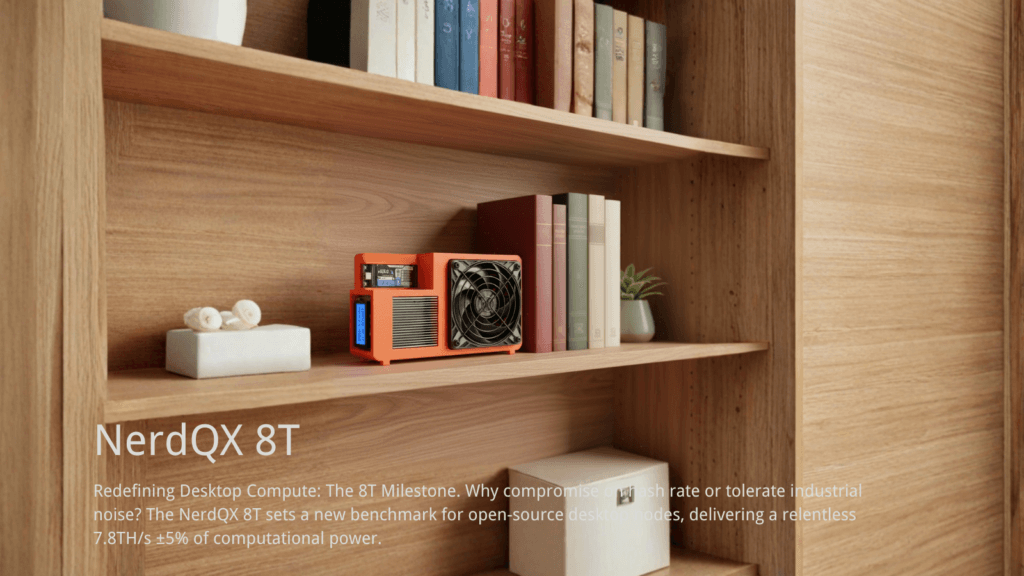
From cryptography teaching to cybersecurity experiments, from blockchain courses to ASIC architecture demonstrations, desktop-grade miners are rapidly becoming the new experimental equipment for universities and STEM institutions.
Chapter 1: A Neglected New Market is Forming
From Home Miners to Educational Equipment
Over the past decade of technological advancement, Application-Specific Integrated Circuit (ASIC) miners have undergone three profound identity shifts. Initially, they were exclusively “production tools” hidden within massive industrial mining farms. Later, with the maker culture revival, they entered the homes of tech enthusiasts as “geek toys.” Today, a hardcore and long-neglected blue ocean market is rapidly taking shape: desktop miners are accelerating their evolution into “educational experimental equipment” for universities and academic institutions.
This transition is not accidental. Looking back at computer education history, microcontrollers were once considered exclusive to factory control lines—until the Arduino emerged, providing a unified standard hardware platform for electronic engineering education. Similarly, the Raspberry Pi brought complex Linux systems and embedded development to the threshold of mainstream classrooms. Today, facing the booming demand for blockchain engineering and distributed network security education, academia is searching for a teaching medium that combines physical presence with high-certainty algorithms.
This is exactly why the desktop ASIC factory direct model is capturing the attention of global educational procurement directors: it is becoming the next-generation standard experimental platform for the blockchain education era.
Chapter 2: Why There is a Huge Gap in Traditional Blockchain Pedagogy
PPTs Cannot Make Students Truly Understand Bitcoin
Currently, hundreds of university computer science departments globally offer courses related to blockchain, cryptography, or distributed systems. However, educators face a common bottleneck in traditional teaching models: instruction remains heavily confined to paper and virtual simulations. Complex concepts such as the SHA256 algorithm, Nonce iteration, Mining, dynamic Difficulty adjustments, and Block Rewards usually follow a rigid path:
Textbook Theory ➔ PPT Animations ➔ Closed-Book Final Exams
This purely logical deduction results in students who “know the definitions but have never touched the network.” Students can memorize the mathematical formula for Bitcoin, but they cannot practically answer engineering questions: How do hardware miners maintain high concurrency in a real P2P network? How are blocks broadcasted and confirmed on a physical chain? In a fiercely competitive hashing pool, how is a Share (proof-of-work submission) mathematically verified?
A blockchain lab without physical hardware support is like a chemistry class without test tubes or an aerospace department without a wind tunnel—there is a massive gap in experiential learning.
Chapter 3: How Desktop ASICs Become “Teaching Models” in Blockchain Labs
Making Abstract Algorithms Visible
Introducing desktop ASIC miners into the classroom fundamentally materializes abstract code logic into an observable “teaching model.” Through the operation of real devices, students can intuitively and quantitatively deconstruct complex underlying blockchain consensus mechanisms in a lab environment:
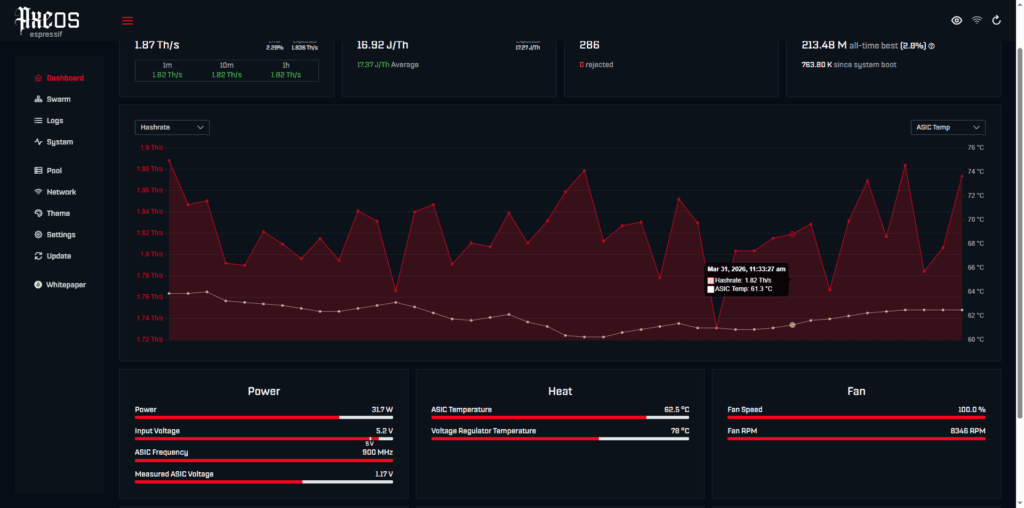
- Materializing SHA256 Computations: Students can observe ASIC chips performing high-frequency hash calculations at ultra-low power in real-time. Through data interfaces, they can monitor the fluctuation of millions of hashes per second, instantaneous changes in Nonce values, and how hardware dynamically adjusts to solve difficulty targets based on global hashrate.
- Transparent Mining Mechanisms: By connecting the miner to a local LAN or a dedicated educational Mining Pool, students can witness how a miner connects to a pool, frequently submits shares that meet difficulty requirements, and broadcasts the block across the network upon successfully solving it.
- Physical Validation of Blockchain Security: Through hashrate allocation experiments across multiple devices, students gain an engineering-level understanding of why Proof-of-Work (PoW) prevents double-spend attacks and why hashrate competition ensures the immutability of a decentralized ledger. This transforms the “invisible” security foundation of the Bitcoin network into a “visible” lab report.
Chapter 4: Four Major Scenarios for University Miner Procurement
In the landscape of higher education, desktop ASIC miners seamlessly integrate into four mainstream laboratory scenarios across Computer Science, Information Security, and Electrical Engineering departments:
Scenario 1: Applied Cryptography Labs (Cryptographic Systems)
- Experimental Content: Hardware acceleration experiments for SHA256 hash functions, engineering probability testing of Hash Collisions, and mathematical boundary verification of Proof of Work.
- Core Value: Transforms dry, abstract mathematical cryptography into real, high-speed computational processes based on physical chips.
Scenario 2: Blockchain Engineering Courses (Distributed Ledger Systems)
- Experimental Content: Running and interconnecting local private blockchain nodes, global hashrate distribution and settlement mechanisms, and multi-node consensus verification and fork simulation.
- Core Value: Builds a highly controllable, real on-chain physical experimental environment without relying on external internet connections.
Scenario 3: Cybersecurity Labs (Cybersecurity & Embedded Security)
- Experimental Content: Using tools like Wireshark for network packet sniffing and deconstruction of the Stratum protocol, Firmware Auditing on miner control boards, and IoT device vulnerability scanning.
- Core Value: As a typical, highly integrated modern industrial IoT device, the desktop miner is a perfect specimen for studying embedded system security and proprietary network protocols.
Scenario 4: Computer Architecture Courses (Hardware Acceleration)
- Experimental Content: General computing vs. specialized acceleration benchmark experiments (CPU vs. GPU vs. FPGA vs. ASIC), and efficiency analysis of fixed-point arithmetic vs. logic gate arrays.
- Core Value: Allows students to profoundly understand why ASICs can achieve a 100x energy efficiency ratio over general-purpose processors in specific mathematical calculations (like SHA256).
Chapter 5: The STEM Education Market Might Be Larger Than Universities
K12 STEM is Looking for New Teaching Tools
Beyond traditional higher education, the global K12 STEM (Science, Technology, Engineering, and Mathematics) education market exhibits an even more massive hardware procurement potential. Over the past decade, STEM schools and maker spaces have bulk-purchased Arduino (for basic electronic programming), Raspberry Pi (for underlying computer logic), and NVIDIA Jetson Nano (for entry-level AI edge computing).
However, the core frontier of modern Interdisciplinary Education is the digital economy and network security. Schools urgently need a comprehensive teaching tool that seamlessly integrates Mathematics (cryptographic hashes), Programming (script control), Networking (P2P communication), Hardware (ASIC integrated circuits), and Frontier Digital Science (blockchain technology). The desktop ASIC Blockchain Lab Kit, supplied directly by DigLucky, fills this exact void, becoming the new benchmark for STEM educational hardware upgrades.
Chapter 6: Why the Luckyminer LV07 is the Perfect Educational Product
Four Strict Educational Requirements & Key Engineering Specifications
Traditional industrial miners come with terrifying power consumption reaching thousands of watts and deafening noise exceeding 75 decibels, making them impossible to deploy in standard classrooms. Designed specifically for educational and commercial research environments, DigLucky introduces the ultimate laboratory instrument: the Luckyminer LV07.
This model completely discards brutal industrial designs, achieving a comprehensive “education-friendly” upgrade across core engineering metrics:
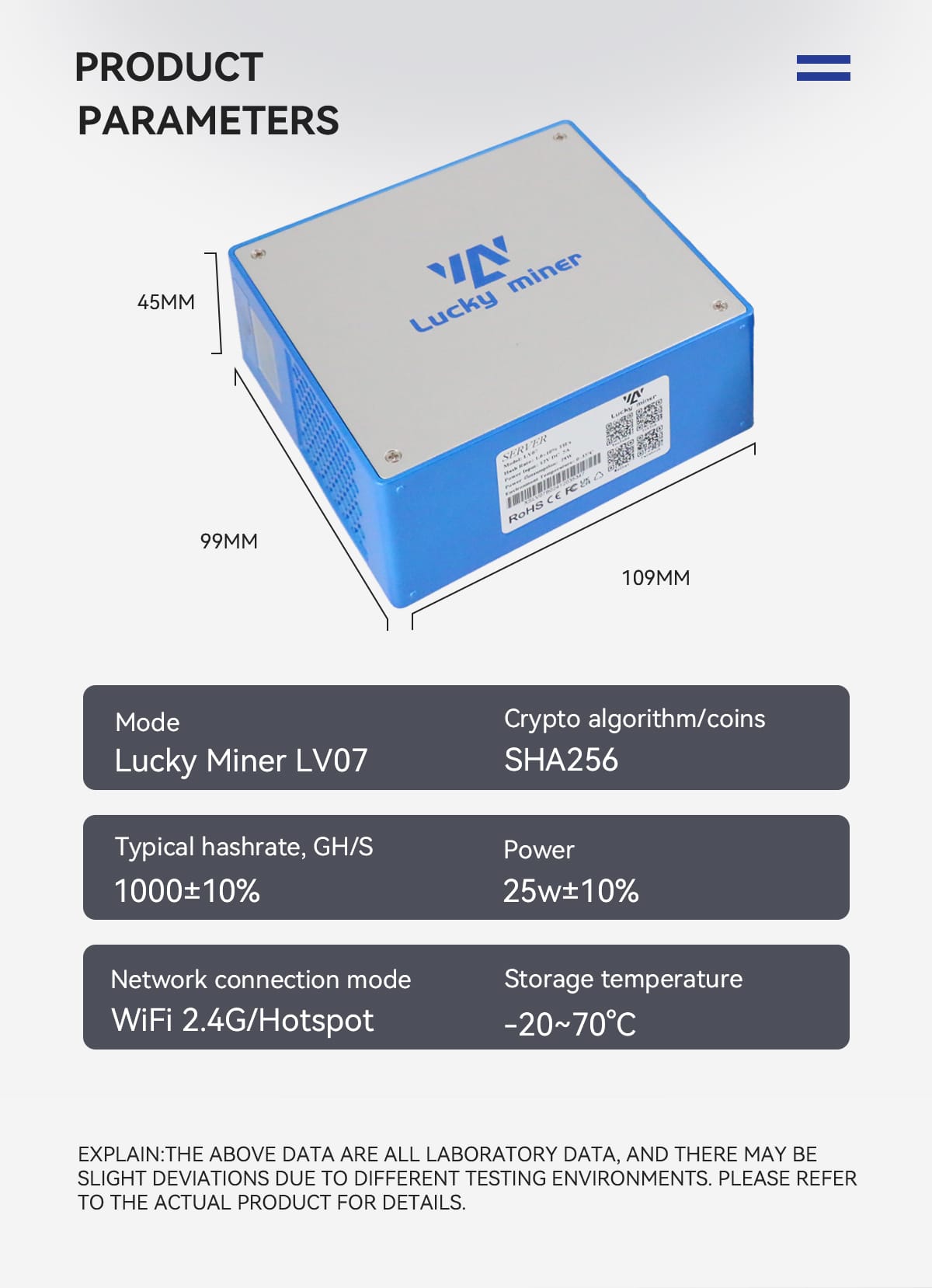
Key Engineering Specifications of Luckyminer LV07:
- Targeted SHA256 Validation: Engineered to deliver a highly stable cryptographic hashrate of 1.0 TH/s (±10%), specifically calibrated for the SHA256 algorithm to support multi-asset networks including BTC, BCH, and BSV demonstrations.
- Ultra-Efficient Power Architecture: Operates at a microscopic power envelope of merely 25W (±10%) at a baseline ambient temperature of 25°C. Utilizing a globally compliant 100~240V AC to 12V/5A power adapter, it allows for plug-and-play functionality, drastically reducing continuous operational expenditure (OPEX) for large-scale laboratory deployments.
- Commercial Acoustic Compliance: Outfitted with an active thermal extraction framework that strictly caps operational noise at ≤ 38 dBA. This whisper-quiet performance ensures frictionless integration of Master Carton batches into noise-sensitive classroom environments or commercial office spaces.
- Autonomous Wireless Provisioning: Features an embedded 2.4GHz WiFi and mobile hotspot module to bypass dedicated Ethernet cabling constraints. This architecture enables rapid, capital-efficient node provisioning for regional educational integrators.
Applicability Comparison: Industrial vs. Desktop Educational ASIC
| Evaluation Dimension | Traditional Industrial Miner | Luckyminer LV07 (Desktop) | Lab Applicability Rating |
| Acoustic Noise | Extreme (> 75 dBA), needs isolation | Ultra-Low (≤ 38 dBA), ambient | High — Safe for lectures |
| Power / PSU | Extreme (3000W+), requires 220V | Micro (25W), standard 12V/5A | High — Standard classroom outlets |
| Deployment Control | Complex, requires heavy infrastructure | Zero-barrier, 2.4GHz WiFi/Hotspot | High — Minutes to deploy |
| Educational Purpose | Solely designed for commercial ROI | Transparent algorithmic teaching | High — Focused on academia |
Chapter 7: How Educational Institutions Can Build a Blockchain Lab
Standard 20-Seat Configuration & Master Carton Procurement Guide
To help global university procurement directors and STEM training institutions quickly implement hardware teaching capabilities, DigLucky’s senior educational supply chain team has designed the following efficient, closed-loop standard laboratory configuration for a 20-student class:
- Instructor Terminal (1 Set): 1 High-performance full-node server (running local Bitcoin Core), connected to a multimedia projection system for real-time monitoring.
- Student Benches (10 to 20 Sets): 10 to 20 Luckyminer LV07 desktop miners, with one Raspberry Pi (Linux environment) serving as a control terminal for every 1-2 students.
- Teaching Software Stack: Bitcoin Core (open-source ledger), Wireshark (network protocol analysis), Linux OS, and an open-source Stratum local server.
Master Carton Bulk Program for Institutions:
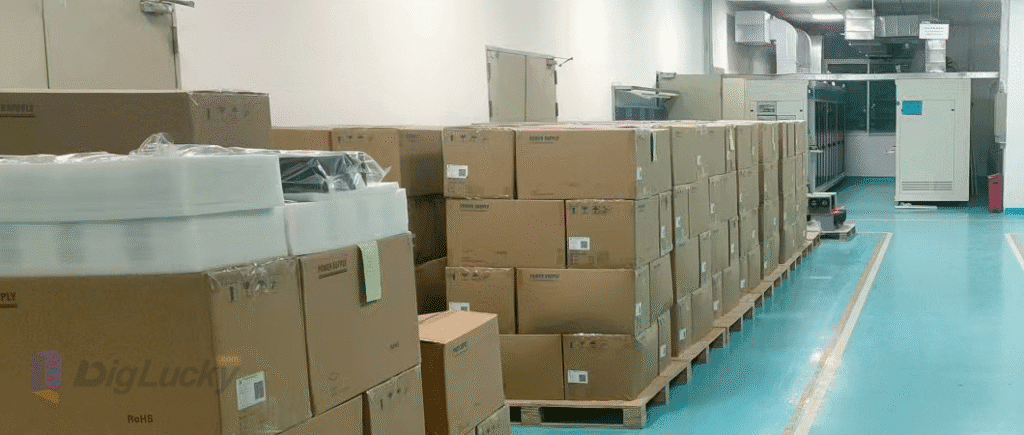
To support global academic infrastructure, DigLucky has launched an exclusive Master Carton Wholesale Pricing system for legitimate universities, computer science departments, and STEM institutions. Educational organizations can contact DigLucky’s official supply chain team to access desktop ASIC factory direct quotes and specialized bulk logistics support, eliminating retail markups and maximizing the efficiency of academic funding.
Under this configuration, every lab session forms a rigorous closed-loop: Theory Lecture ➔ Local Full Node Configuration ➔ Luckyminer LV07 Physical Hashrate Injection ➔ Stratum Network Packet Sniffing ➔ Cryptography Lab Report Drafting.
Chapter 8: From Arduino to ASIC — The New Evolution of Educational Hardware
The “Arduino” of the Blockchain Era
Looking at the trajectory of global tech education hardware over the past two decades, a clear conclusion emerges: every critical technological era is accompanied by an irreplaceable hardware/software teaching platform. In the era of electronic engineering, the foundation was Arduino. In the explosive era of deep learning, AI education relied on NVIDIA GPUs / Jetson Nano. Today, as distributed computing and decentralized security become institutionalized, the hardcore standard for blockchain education will inevitably evolve into the golden combination of “Node + Desktop ASIC.”
As a pioneer in this evolutionary tide, the Luckyminer LV07 is crossing the narrow boundaries of traditional mining. It is no longer a machine existing purely for fiat returns; it is the “Arduino” of the blockchain engineering and cybersecurity era, accessible to every student.
Conclusion: The True Value of a Miner is Not Just Mining
When the general public talks about an ASIC miner, the focus is almost always on Return on Investment (ROI) and how much cryptocurrency it can generate. But for educational institutions tasked with cultivating the next generation of elite engineers, a much more valuable question is: What does this machine actually help our students understand?
Desktop ASIC miners are taking on this entirely new historical role—they are no longer cold computational devices, but physical experimental platforms connecting cryptography, computer science, network security, and blockchain engineering. Perhaps in the near future, the first miner to enter a top-tier university’s computer lab will not be there to generate commercial profit, but to build the next generation of outstanding engineers who will reconstruct the future network of trust. In this educational infrastructure upgrade, DigLucky remains committed to providing the most professional and compliant foundational hardware for global academia through its desktop ASIC factory direct capabilities.
Start Your Project Today
Submit your requirements (even if they’re just an idea) and our B2B team will contact you within 48 business hours.