1. The U.S. ASIC Import Landscape: Regulatory & Economic Realities
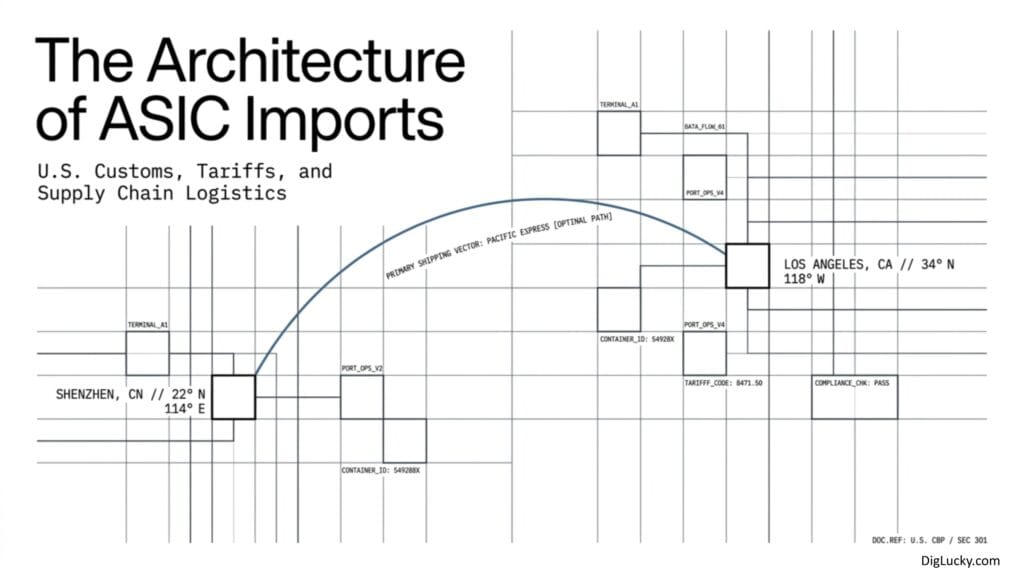
The North American market for desktop ASIC nodes, STEM educational clusters, and micro-datacenter infrastructure has shifted decisively from casual consumer ordering to institutional procurement. For hardware distributors, university blockchain laboratories, and enterprise facility engineers, sourcing bulk hardware directly from China’s manufacturing hub in Shenzhen requires a transparent understanding of international trade compliance.
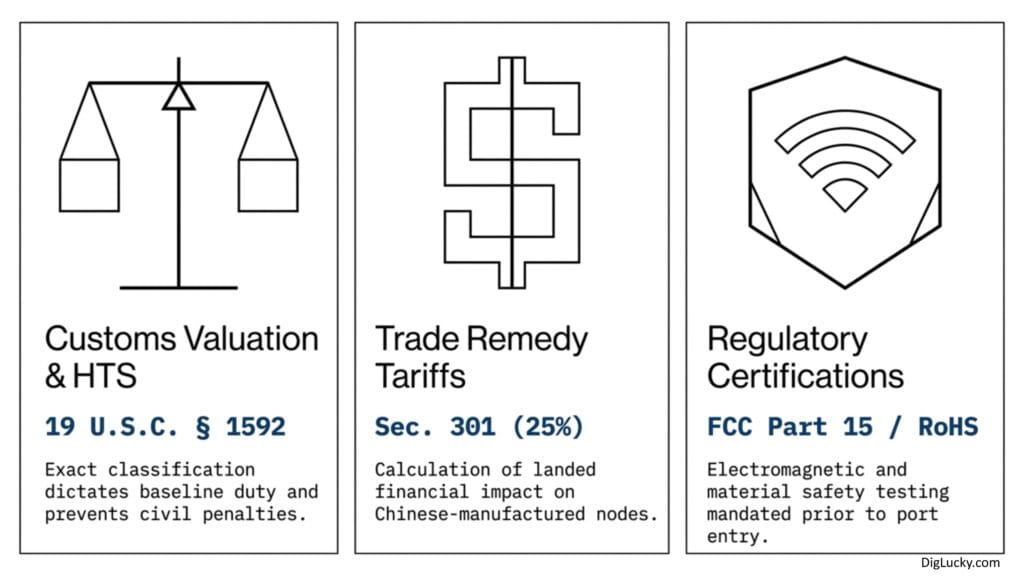
Navigating U.S. imports is governed by three primary pillars:
- Customs Valuation and Classification: Ensuring precise Harmonized Tariff Schedule (HTS) code assignment to avoid civil penalties under 19 U.S.C. § 1592.
- Trade Remedy Tariffs: Calculating the landed financial impact of Section 301 tariffs on Chinese-manufactured computational equipment.
- Electromagnetic and Safety Certifications: Fulfilling FCC Title 47 CFR Part 15 regulatory testing and RoHS material safety standards prior to entry at U.S. ports.
Procuring directly from the source manufacturer ensures that commercial documentation, physical packaging integrity, and technical conformity declarations align precisely with CBP requirements, eliminating clearance bottlenecks.
2. Technical Customs Architecture: HTS Classification & Tariff Calculations
Harmonized Tariff Schedule (HTS) Codes
Accurate classification under the U.S. Harmonized Tariff Schedule is the legal responsibility of the Importer of Record. For dedicated cryptographic hardware and desktop ASIC micro-nodes, the following classifications govern entry:
- HTS 8471.50.0150: Digital processing units (computational engines without dedicated displays or peripherals), general duty free (0%), subject to Section 301 ad valorem duty.
- HTS 8543.70.9960: Electrical machines and apparatus having individual functions, not specified elsewhere (applied to dedicated cryptographic computing modules), 2.6% base duty + Section 301 ad valorem duty.
- HTS 8542.31.0000: Electronic integrated circuits (Bare ASIC silicon processors such as BM1370 / BM1368), 0% base duty.
- HTS 8473.30.5100: Printed circuit board assemblies (PCBA) and sub-assemblies for data processing machines, 0% base duty + Section 301 duty.
Section 301 Tariff Mechanics and Fees
Hardware originating from mainland China falls under Section 301 tariffs (List 1 and List 2 designations), imposing an additional 25% ad valorem tariff on top of the base HTS duty rate.
Beyond standard tariffs, U.S. commercial entries are subject to federal processing fees:
- Merchandise Processing Fee (MPF): An ad valorem fee of 0.3464% for formal entries (shipments valued over $2,500), capped at a minimum of $31.67 and a maximum of $614.35 per entry.
- Single Entry / Continuous Customs Bond: Required for all commercial shipments exceeding $2,500 in customs value or containing commodities regulated by other government agencies (such as the FCC).
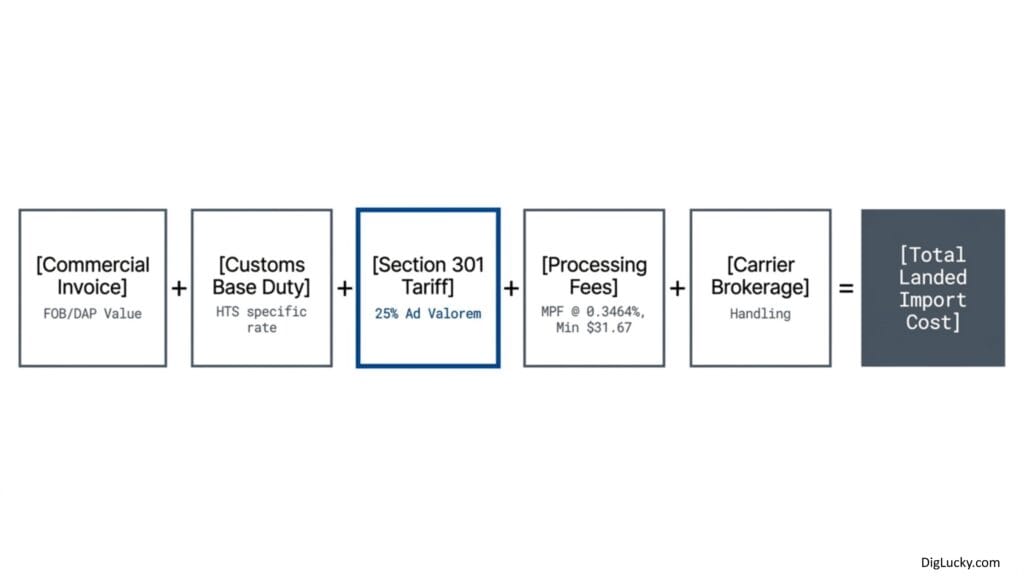
3. Financial & Logistics Comparison: Landed Cost & Incoterms Analysis
Understanding trade terms is critical for enterprise balance sheets. DigLucky standardizes shipments on DAP (Delivered at Place), optimizing cost control, regulatory compliance, and tax visibility compared to high-risk DDP or complex EXW frameworks.
U.S. Customs & Logistics Matrix
| Parameter / Incoterm | EXW (Ex Works Shenzhen) | DAP (Delivered at Place) – DigLucky Standard | DDP (Delivered Duty Paid) via Middlemen |
| Freight Management | Buyer coordinates forwarder | DigLucky executes priority air freight (DHL/UPS) | Trader coordinates freight |
| Transit Lead Time | 7–14 business days | 5–7 business days to major U.S. hubs | 10–20 business days (often consolidated) |
| Customs Clearance | Buyer / Buyer Broker | Buyer / Express Carrier Brokerage | Middleman / Unverified third party |
| Duty & Tariff Payment | Direct to CBP via broker | Direct to Carrier/CBP (100% compliant) | Bundled into markup (frequently misdeclared) |
| CBP Form 7501 Receipt | Issued directly to Buyer | Issued directly to Buyer (Tax deductible) | Unavailable or falsified |
| Shipment Tracking | Carrier-dependent | End-to-end Tier 1 AWB Tracking | Unreliable regional tracking |
| Risk of Customs Seizure | Low (if broker is compliant) | Extremely Low (Certified documents attached) | High (due to grey-market undervaluation) |
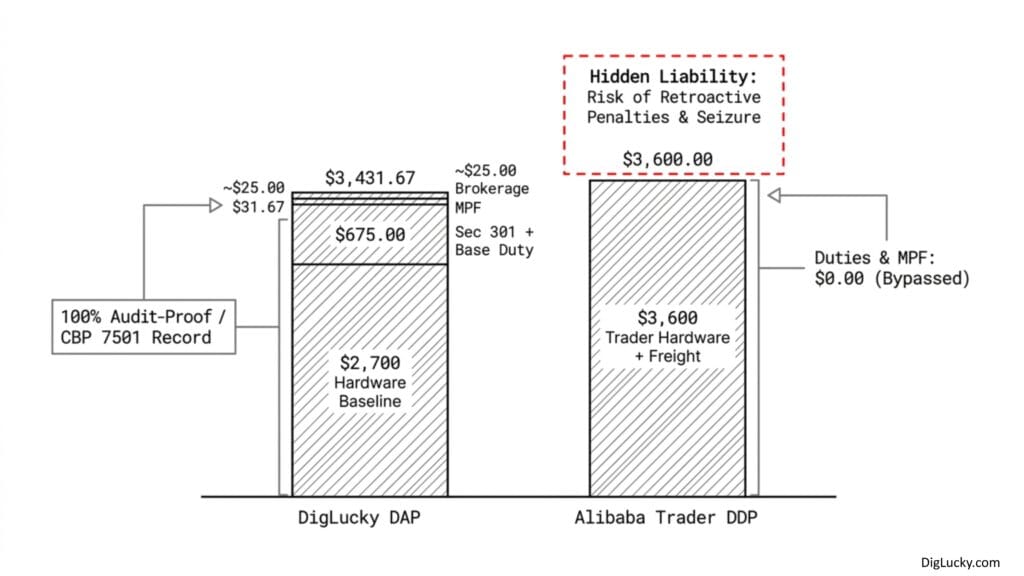
Enterprise Landed Cost Simulation: 20-Unit Master Box (e.g., LuckyMiner LV08 Pro)
| Line Item | Source Factory (DigLucky DAP) | Alibaba Trader (DDP “All-Inclusive”) |
| Hardware Baseline (20 Units) | $2,700 (Factory Tier 1 Pricing) | $3,600 (Trader Markup Included) |
| Air Freight Logistics | Included in DAP Master Box Price | Included in Quote |
| Section 301 Tariff (25%) + Base Duty | $675.00 (Direct CBP Bill) | $0.00 (Hidden via illicit under-invoicing) |
| Merchandise Processing Fee (MPF) | $31.67 | $0.00 (Bypassed illegally) |
| Carrier Brokerage Fee | ~$25.00 – $40.00 | $0.00 |
| Total Landed Investment | $3,431.67 | $3,600.00 |
| Legal Compliance Status | 100% Audit-Proof with CBP 7501 Record | High Liability; Risk of Retroactive Penalties |
4. Regulatory & Hardware Compliance: FCC Title 47 & Safety Mandates
When importing ASIC hardware into the United States, commercial electronics must comply with Federal Communications Commission standards for unintentional radiators under Title 47 CFR Part 15, Subpart B.
All DigLucky hardware—including commercial lines (LuckyMiner, MagicMiner) and open-source flagships (Bitaxe Gamma 602, NerdQaxe++, NerdOctaxe 12T)—is manufactured and tested to meet international standards:
- FCC Part 15 Class A/B Verification: Ensures electromagnetic interference (EMI) generated by high-frequency ASIC switching clocks (e.g., 500 MHz to 800 MHz on BM1370/BM1368 chips) does not disrupt commercial or residential radio frequency communications.
- CE & UKCA Alignment: Full compliance across electromagnetic compatibility (EMC) and low-voltage electrical safety directives.
- RoHS Directive Compliance: Verification that all PCBA components, lead-free solder alloys, and surface-mount components contain no hazardous materials above legal limits.
- Power Supply Certification: DigLucky bundles UL/cUL-recognized or CE/FCC-compliant 5V/12V power supply units configured with standard U.S. NEMA 1-15P or NEMA 5-15P AC plugs.
Official test reports, Declarations of Conformity (DoC), and technical datasheets are generated during the Proforma Invoice (PI) phase to accompany customs manifests.
5. Standard Operating Procedure (SOP): Enterprise U.S. Import Execution
To guarantee a frictionless import process, procurement teams should execute the following 5-phase procurement protocol:
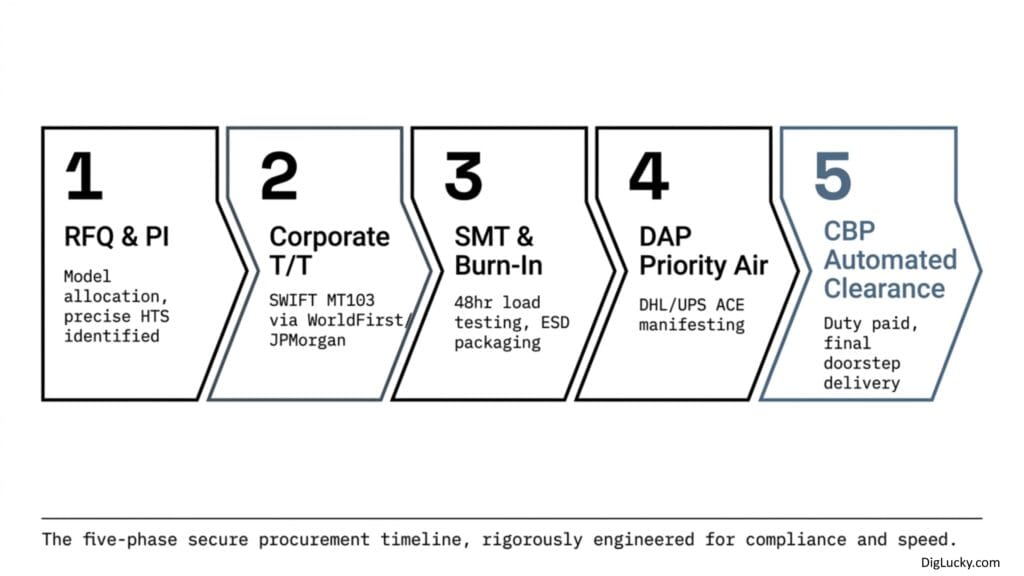
Phase 1: RFQ and Allocation
- Enterprise buyers submit specific model and volume requirements (e.g., 50 units of NerdQaxe++ 6T or 100 units of Bitaxe Gamma 602).
- DigLucky issues a formal Proforma Invoice (PI) outlining HTS classifications, model-specific Master Carton dimensions, gross weight, and tax-exclusive DAP terms.
Phase 2: Secure Corporate Financial Settlement
- Payment is executed via official corporate Telegraphic Transfer (T/T) in USD to DigLucky’s WorldFirst corporate account routing directly through Tier-1 banking partners (e.g., JPMorgan Chase Bank).
- Transaction slips (SWIFT MT103) are verified, locking in hardware allocation and triggering factory scheduling.
Phase 3: SMT Assembly, Testing, and Packaging
- Units undergo final surface-mount inspection and a mandatory 48-hour continuous burn-in load test in our Shenzhen/Beijing facilities.
- Hardware is sealed into reinforced, drop-tested export Master Cartons fitted with custom ESD (electrostatic discharge) protective foam inserts.
Phase 4: DAP Priority Air Freight Dispatch
- Cargo is transferred to DHL or UPS Express air networks at Shenzhen (SZX) or Hong Kong (HKG) international gateways.
- Master Air Waybill (AWB) is generated, linking the commercial invoice and packing list directly to CBP’s Automated Commercial Environment (ACE).
Phase 5: Customs Clearance & Final Delivery
- Upon arrival at the U.S. port of entry (e.g., Anchorage, Cincinnati, Louisville, Los Angeles), the express carrier acts as customs broker.
- For shipments over $2,500, the buyer provides their IRS Employer Identification Number (EIN) or continuous bond details.
- The buyer receives an automated duty assessment invoice from the carrier for Section 301 tariffs and MPF.
- Following electronic clearance, the carrier executes final doorstep delivery to the buyer’s warehouse, laboratory, or office.
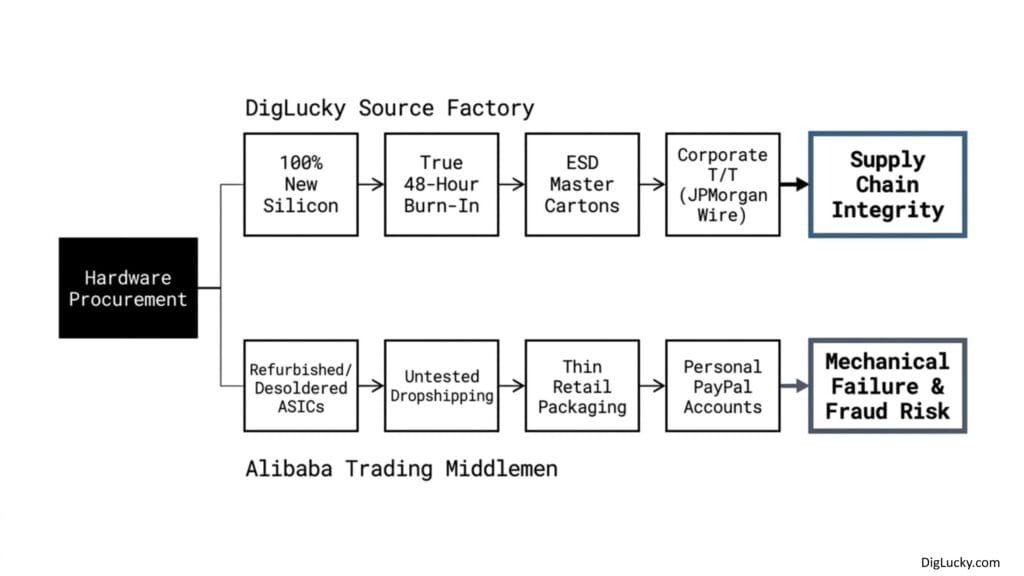
6. Factory-Floor Authority: DigLucky Manufacturing vs. Trader Drop-Shipping
Sourcing enterprise electronics from China requires strict differentiation between genuine original equipment manufacturers (OEM) and non-technical trading middlemen.
1. Silicon Authenticity & Thermal Reliability
- DigLucky Standard: We utilize 100% brand-new silicon wafers (Bitmain-grade BM1370, BM1368, and BM1366 ASICs) sourced directly from verified foundry allocations. Hashboards are built using solid-state capacitors and multi-layer thermal PCB layouts.
- Trader Risk: Secondary brokers frequently harvest degraded ASIC chips from decommissioned industrial mining rigs, resoldering them onto low-cost boards that suffer thermal failure within weeks.
2. Rigorous 48-Hour Burn-In Protocol
- DigLucky Standard: Every unit operates under full computational load for 48 continuous hours in our climate-controlled test racks. We monitor error rates, core voltage stability, and thermal dissipation to ensure a near-zero Dead-on-Arrival (DOA) rate.
- Trader Risk: Brokers visually inspect units without running burn-in tests, leaving the buyer to absorb hardware failure rates exceeding 8–15%.
3. Packaging & Mechanical Protection
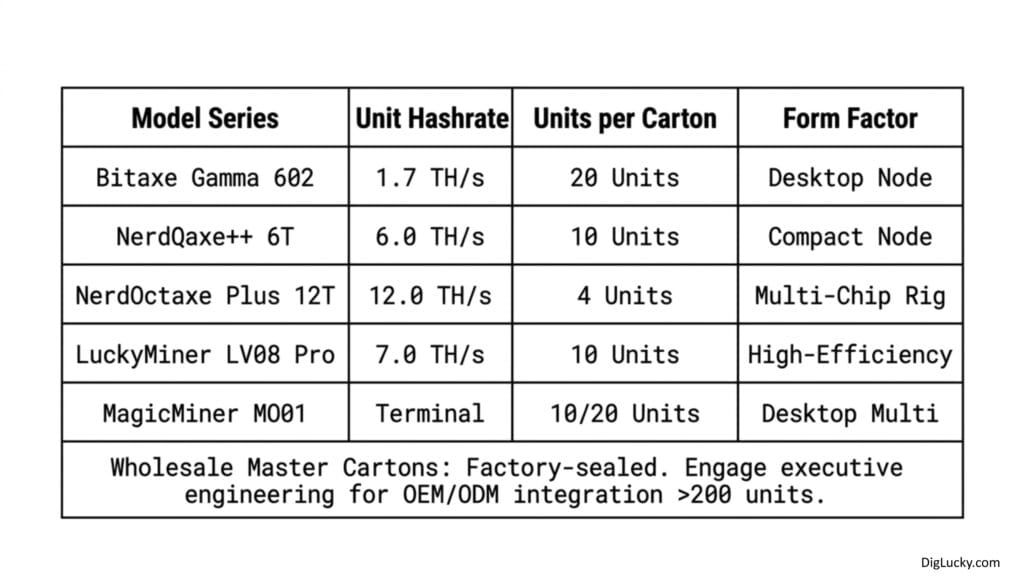
- DigLucky Standard: Orders ship in heavy-duty, double-walled Master Cartons (4, 10, or 20 units depending on chassis weight) with high-density precision-cut foam bays.
- Trader Risk: Loose packing in single thin cardboard boxes results in damaged cooling fans, cracked heatsinks, and fractured solder joints during international air transit.
7. Common Supply Chain & U.S. Customs Pitfalls
Pitfall 1: The “DDP All-Inclusive” Fraud Trap
Many Chinese trading companies offer “DDP shipping” at prices lower than the legal 25% Section 301 tariff rate. They achieve this by utilizing illegitimate consolidated logistics channels that misclassify ASICs as “plastic toys” or “low-value electrical parts” valued under the $800 Section 321 de minimis threshold.
- The Consequence: CBP audits routinely flag, seize, or confiscate misdeclared electronics shipments. As the beneficial recipient, U.S. buyers face civil asset seizure and severe regulatory scrutiny.
Pitfall 2: Overlooking Continuous Customs Bond Requirements
First-time enterprise buyers ordering shipments exceeding $2,500 without a continuous customs bond often encounter carrier clearance delays.
- The Solution: Establish an account with DHL Express or UPS Supply Chain Solutions with your corporate EIN on file, or obtain an annual continuous bond (~$400–$500/year) to enable automated instantaneous clearance.
Pitfall 3: Inadequate Voltage and Frequency Planning
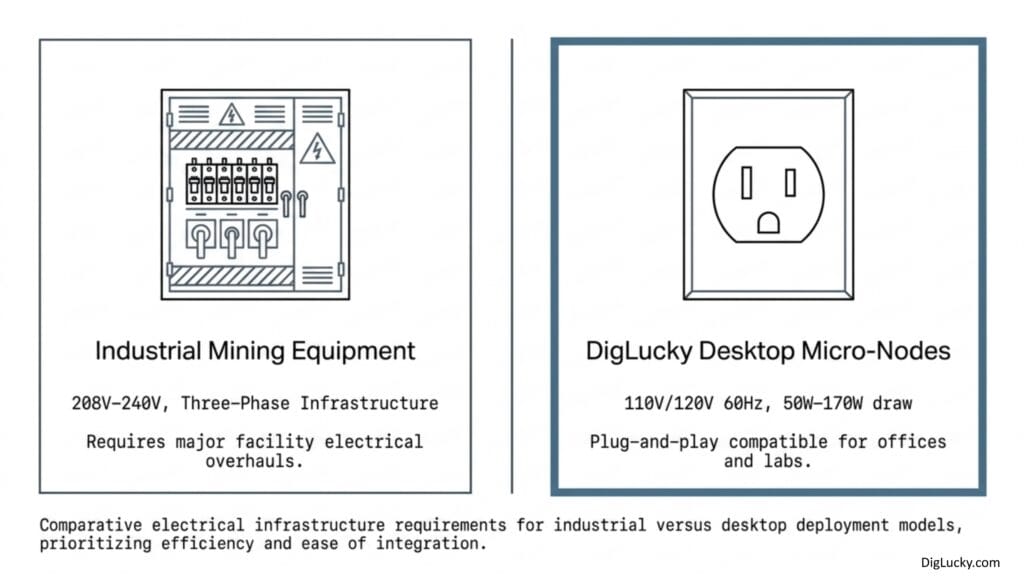
Industrial mining equipment requires 208V–240V three-phase infrastructure, creating deployment issues for standard offices or laboratories.
- The Solution: DigLucky specializes in desktop-class, ultra-silent micro-nodes (e.g., 50W to 170W) engineered for standard U.S. 110V/120V 60Hz wall outlets, requiring no electrical overhauls.
8. Enterprise Diagnostic & Compliance FAQ
Q1: Why does DigLucky ship under DAP terms rather than DDP to the United States?
DAP (Delivered at Place) guarantees absolute legal transparency. Under DAP, DigLucky covers all export processing, air freight logistics, and door-to-door transit to your U.S. facility, while the buyer pays the exact, uninflated Section 301 duties and customs fees directly to the carrier or CBP. This ensures the buyer receives an official CBP Form 7501 (Entry Summary), providing proof of legal import and enabling standard corporate asset capitalization and tax deductions.
Q2: What documentation accompanies our bulk shipment for CBP clearance?
Every DigLucky Master Carton shipment is manifested with a detailed commercial invoice stating the exact SKU, unit value, serial numbers, correct HTS code (8471.50.0150 or 8543.70.9960), packing list, and country of origin certificates. Additionally, FCC and CE compliance certifications are maintained on file for regulatory verification.
Q3: How are customs duties billed and paid during DAP air freight delivery?
When the aircraft enters U.S. airspace, DHL or UPS electronically transmits manifest data to CBP. If duty is assessed, the carrier contacts the recipient via email/phone with an electronic payment link, or automatically charges the buyer’s carrier billing account if an EIN is linked. Once paid, the shipment immediately proceeds to final-mile dispatch.
Q4: What is the transit lead time from DigLucky’s factory floor to major U.S. metropolitan hubs?
In-stock commercial units (LuckyMiner, MagicMiner) dispatch within 24 to 48 hours of payment settlement. Standard open-source master boxes dispatch within 3 to 7 business days following custom flashing and burn-in testing. Priority DAP air freight transit to major U.S. hubs (New York, Chicago, Dallas, Los Angeles, Atlanta) averages 5 to 7 business days.
Q5: How does DigLucky secure high-value wire payments for bulk orders?
All B2B wholesale transactions are settled via corporate Telegraphic Transfer (T/T) in USD. Payments are routed through WorldFirst to our verified corporate accounts held at Tier-1 institutions, including JPMorgan Chase Bank. We provide complete corporate registration documentation and Proforma Invoices to satisfy internal enterprise procurement compliance.
9. Master Box Wholesale & OEM Procurement: Next Steps
DigLucky provides direct factory access for tech distributors, mining farms, and corporate hardware integrators seeking margin protection and uncompromised silicon quality.
Initiate Your Commercial Procurement
Engage Directly with Factory Engineering: Connect via WhatsApp or email to discuss technical specifications, schedule factory audits, and lock in production timelines.
Explore Wholesale Master Cartons: Review baseline Tier 1–Tier 3 pricing for factory-sealed boxes directly on our B2B Wholesale Portal.
Request an Enterprise Proforma Invoice: Contact our executive engineering team for custom OEM/ODM configurations (RJ45 Ethernet integration, bespoke firmware, branded packaging, or volume allocations above 200+ units).
Ready to Start Your Project?
Get a factory-direct quote for your B2B project, or shop our B2C store for the best prices.