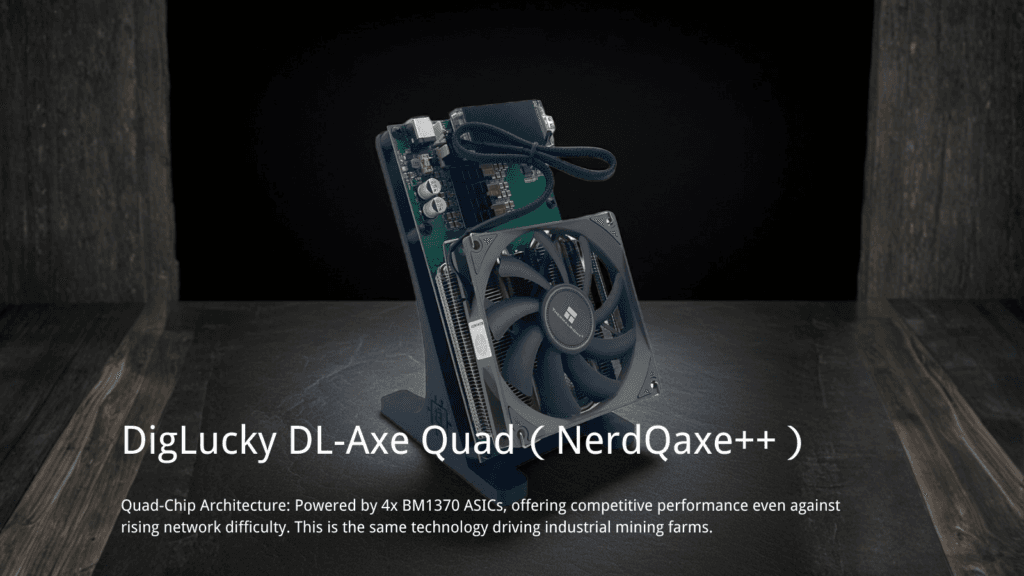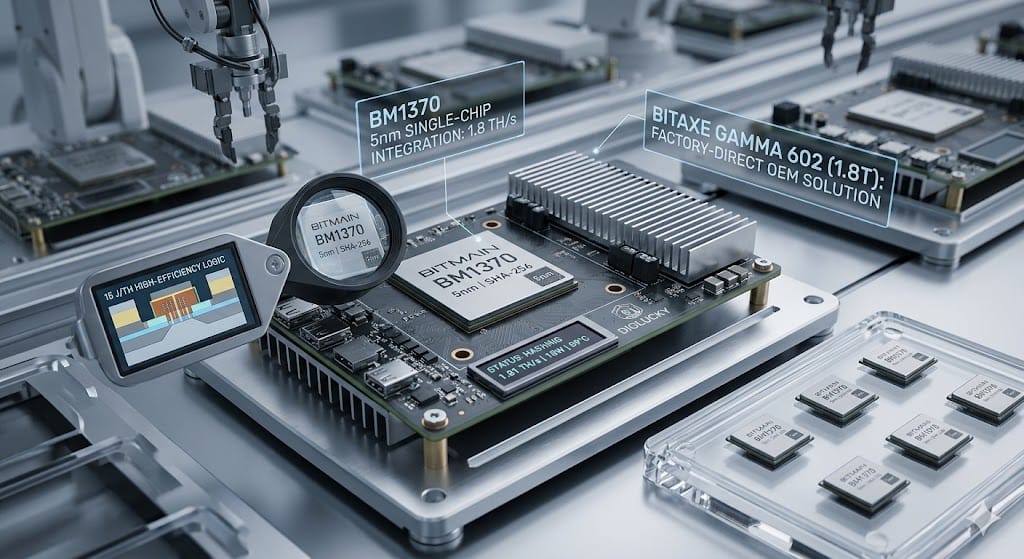
In 2026, the 5nm ASIC revolution led by the BM1370 chip establishes a strict new benchmark for desktop mining operations. Achieving a precise 15 J/TH efficiency, these single-chip units deliver up to 1.8 TH/s while drawing a mere 18W of power. DigLucky’s automated mass production of the Bitaxe 602 translates these raw hardware metrics into guaranteed operational stability and highly competitive, future-proof inventory for global B2B distributors.
Harnessing 5nm ASIC Single Chip Integration OEM Capabilities in 2026
The shift to the 5nm silicon fabrication node represents a massive reduction in gate capacitance and switching losses. The BM1370 is the pinnacle of this shift, designed for high-density industrial deployments but now optimized by DigLucky engineers for single-chip desktop form factors. Our 15 J/TH desktop ASIC mass production line utilizes precision power delivery networks to feed this chip exactly what it needs, bypassing the severe thermal constraints that plague older generations.
For wholesale distributors, this means deploying hardware that operates silently in office environments while rivaling the efficiency metrics of top-tier server-rack machines. Supplying 1.8 TH/s at sub-20W power thresholds fundamentally alters the ROI timeline for end-users, ensuring that your inventory remains highly desirable regardless of network difficulty spikes.
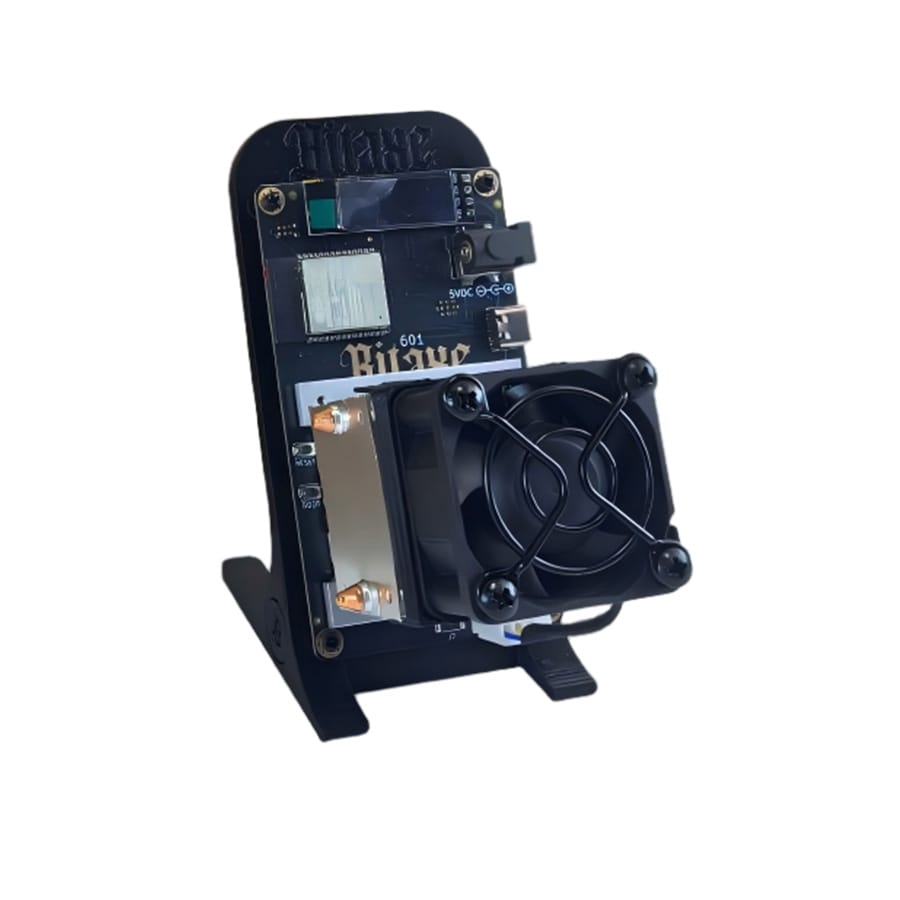
Industrial SOP: Provisioning the Bitaxe 602 at 1.8 TH/s
Proper initialization of high-density ASICs requires strict adherence to factory-approved sequences. Distributing this SOP to your client base minimizes RMA requests and ensures peak performance.
- Verify the 5V Power Delivery Network: Connect a high-quality, continuous-rated 5V/4A DC power supply. The BM1370 requires zero voltage sag during hashing spikes. Substandard adapters will cause immediate phase-lock loops (PLL) failure on the ASIC.
- Initialize AxeOS Boot Sequence: Power the unit and monitor the initial LED diagnostic array. Connect to the local broadcast SSID (
Lucky_XXXX) and navigate to192.168.4.1. The ESP32-S3 microcontroller will report the hardware handshake status with the BM1370. - Calibrate Core Voltage and Frequency: Access the AxeOS settings. For the Bitaxe 602, the factory-validated baseline for 1.8 TH/s is an ASIC frequency of 850MHz paired with a core voltage of 1200mV. Do not exceed these parameters without upgrading the physical heat sink mass.
- Lock Fan PWM Curves: Ensure the cooling fan is set to dynamic PWM control within AxeOS. The system must automatically ramp RPM to keep the BM1370 die temperature strictly under 65°C for optimal 15 J/TH operation.
- Execute Stratum Protocol Handshake: Input the target mining pool stratum URL, port, and worker credentials. Save the configuration and initiate a software reboot to finalize the network handshake and begin hashing.
DigLucky Manufacturing Standards vs. DIY Clone Liabilities
Procuring wholesale BM1370 desktop miner OEM units requires distinguishing between true factory-grade engineering and unreliable hobbyist clones. DigLucky operates fully automated SMT (Surface-Mount Technology) lines, ensuring every component meets strict industrial tolerances. We eliminate the variables of hand-soldering and generic part sourcing.
| Production Metric | DigLucky Factory Standard (2026) | Generic DIY Clone Risks |
| PCBA Assembly | Automated SMT with custom multi-stage reflow profiles. | Hand-soldered ICs leading to microscopic cold joints and failure under load. |
| Thermal Management | Custom-milled aluminum heat sinks with industrial thermal pads. | Misaligned generic heat sinks causing immediate BM1370 thermal throttling. |
| Power Delivery | Precision Texas Instruments buck regulators maintaining exact 5V tolerances. | Cheap step-down modules causing voltage transients and permanent ASIC degradation. |
| Quality Assurance | Mandatory 48-hour continuous burn-in test at 1.8 TH/s. | Zero load testing prior to shipping; high DOA (Dead on Arrival) rates. |
Engineering FAQ: BM1370 Diagnostic Troubleshooting
Q: The AxeOS dashboard reports 0 GH/s, but the system is drawing 5W at the wall.
A: This indicates the ESP32-S3 is running, but the BM1370 is failing to communicate via the UART serial bus. Use a multimeter to verify the 1.2V LDO regulator output on the PCB. If voltage is present, check the system logs for an ASIC NOT FOUND error, which points to a corrupted PLL boot sequence requiring a hard power cycle.
Q: The BM1370 chip temperature rapidly spikes past 75°C, triggering an automatic AxeOS shutdown.
A: The thermal interface is compromised, or the ambient environment exceeds operational limits. Verify the PWM fan is receiving the 5V control signal and spinning at maximum RPM. If airflow is unobstructed, the thermal paste between the ASIC die and the aluminum heat sink must be reapplied using an industrial-grade non-conductive compound.
Q: The miner displays a high rate of hardware errors (HW) and rejected shares despite a stable network connection.
A: You are exceeding the silicon lottery threshold for that specific chip. The frequency is pushed too high for the provided core voltage. Access AxeOS and drop the ASIC frequency by 25MHz increments until the HW error rate stabilizes to less than 0.5% of total submitted shares.
Secure Your 2026 OEM Allocations: B2B Wholesale Logistics
Partnering with DigLucky guarantees direct access to Shenzhen’s hardware supply chain without retail markup. We offer highly customizable white-label OEM modifications, allowing distributors to dictate bespoke firmware, custom I/O configurations, and tailored thermal solutions.
We support Full Carton bulk shipments and secure T/T wire transfers for all global distribution partners. Standardize your hardware offerings and protect your margins with true factory-direct pricing. Contact the DigLucky B2B operations desk today to secure your Q3/Q4 Bitaxe 602 inventory pipeline.
Ready to Start Your Project?
Get a factory-direct quote for your B2B project, or shop our B2C store for the best prices.