In 2026, the BM1370 5nm ASIC, originally engineered for the 234 TH/s Antminer S21 Pro, has been successfully recalibrated for desktop-class single-chip integration. Through precision OEM engineering, this silicon shifts from a megawatt industrial architecture to an 18W–40W desktop envelope, delivering a stable 1.5 TH/s to 1.7 TH/s hashrate with sub-65°C core temperatures for global B2B hardware distributors.
Decoding the 5nm Paradigm: Megawatt to Micro-Watt Architecture in 2026
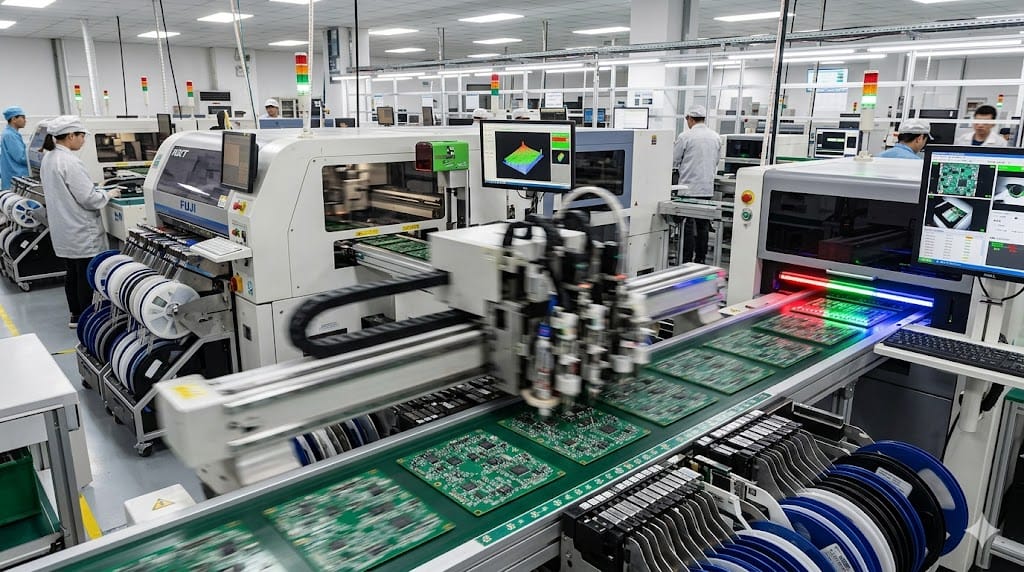
Extracting the BM1370 from Bitmain’s heavy-duty industrial racks and integrating it into single-chip desktop miners like the Bitaxe Gamma 602 represents a massive engineering paradigm shift. At DigLucky, our Shenzhen automated SMT lines have fundamentally re-engineered the power delivery network (PDN) and thermal dynamics to push this 5nm silicon past its standard 1.2 TH/s baseline.
Operating a single chip at higher hash densities radically alters its electrical demands. By restructuring PCB copper traces to handle massive transient current spikes and optimizing AxeOS voltage parameters, we achieve a stable 1.5 TH/s to 1.7 TH/s in mass production. Our R&D facility is actively mapping electrical pathways to push this architecture toward its absolute 2.0 TH/s physical ceiling. For wholesale distributors and B2B procurement teams, mastering this desktop integration is critical for scaling enterprise hardware deployments without sacrificing silicon longevity.
The Data Truth: DigLucky OEM vs. Generic DIY Clones
Procuring open-source mining hardware carries inherent supply chain risks. Generic clones inevitably fail under sustained cryptographic loads due to inferior bill of materials (BOM) selections and lack of rigorous testing. DigLucky’s factory-direct manufacturing eliminates these electrical failure points by utilizing industrial-grade components and comprehensive QA protocols.
| Specification / Metric | DigLucky Factory OEM Standard (2026) | Generic DIY Clone Risk |
| Power Input Requirement | 5V/8A (40W) high-headroom adapter | 5V/3A generic phone chargers (triggers OCP) |
| Power Delivery (PDN) | Premium TPS546A24 Buck Converters | Cheap LDOs causing 0 GH/s voltage drops |
| Stable Hashrate Output | 1.5 TH/s – 1.7 TH/s (24/7 continuous load) | Unstable 1.0 TH/s to 1.2 TH/s (thermal throttling) |
| Assembly & Verification | Automated SMT with SPI & AOI optical inspection | Hand-soldered PCBA with zero post-assembly QA |
| Thermal Interface Material | High-W/mK industrial phase-change thermal pads | Generic thermal grease leading to >75°C core temps |

Industrial-Grade SOP: 1.7 TH/s Single-Chip Integration & Deployment
The following standard operating procedure outlines the factory-level deployment of the BM1370 ASIC for high-frequency desktop hardware.
- Initialize the ESP32-S3 Core Controller: Connect the 5V/8A DC power supply to the barrel jack, then interface the ESP32-S3 module via USB-C. Flash the latest AxeOS firmware utilizing the
esptool.py write_flashterminal command.Engineering Why: The ESP32-S3 manages the exact I2C/UART timing required by the BM1370. Mismatched firmware baud rates or insufficient initial power delivery will result in ASIC communication failure, leading to a failure to initialize the hashing sequence. - Calibrate the 1.2V and 0.8V Reference Rails: Utilize a high-precision digital multimeter to probe the PCB test points prior to applying a hashing load. Verify the TPS546A24 buck converter is delivering exactly 1.2V to the core and 0.8V to the internal LDO.Engineering Why: The 5nm BM1370 transistor gates are highly sensitive to voltage droop. If the 0.8V rail drops below 0.78V, the internal clock and Phase-Locked Loop (PLL) fail to generate Nonces, triggering hardware-level reboot loops and rejected shares at the pool level.
- Apply High-Density Thermal Coupling: Mount the BM1370 utilizing an industrial-grade phase-change thermal pad. Torque the custom heatsink screws precisely to 0.4 Nm to ensure uniform die contact.Engineering Why: At 1.7 TH/s, the localized heat flux on the silicon die is extreme. Insufficient or uneven mounting pressure prevents the EMC2101 PWM controller from accurately reading core temperatures, leading to delayed fan response times and irreversible thermal degradation.
- Execute the 48-Hour Burn-in Test: Deploy the miner to a test Stratum pool, push the frequency via the AxeOS web dashboard to target 1.7 TH/s, and monitor the hardware error logs over a continuous 48-hour window.Engineering Why: Silicon lottery variance dictates that early-life failures (infant mortality) occur within the first 48 hours of extreme thermal and electrical cycling. Factory-grade burn-in guarantees zero-defect shipments for our enterprise B2B partners.
Pro-Level OEM Troubleshooting & Diagnostics
Q: The AxeOS dashboard shows the BM1370 pulling only 5W with a 0 GH/s hashrate.
A: This is a hardware fault known as the “Flatline of Death,” typically caused by PDN failure or severe input power restriction. If you are operating a 1.5T–1.7T profile using a standard 5V/3A adapter, the massive inrush current will lock the ASIC internal logic. You must swap to the DigLucky standard 5V/8A (40W) power supply and execute a deep cold boot (disconnect power for 10 minutes). Probe the TPS546A24 output; if it reads correctly, the issue is strictly input starvation.
Q: The ASIC temperature exceeds 75°C and triggers thermal throttling under a 1.5 TH/s load.
A: Check the EMC2101 logs via the AxeOS API /api/system/statistics. If the PWM fan is registering a 100% duty cycle but temperatures remain critical, the physical thermal coupling has failed—often due to transit shock shifting the heatsink. Power down the unit, unseat the heatsink, clean the die with 99% isopropyl alcohol, and reapply high-W/mK thermal interface material with precise 0.4 Nm torque.
Q: The device continuously reboots 5 seconds after the OLED screen displays the IP address.
A: This indicates a network-loop crash within the ESP32-S3 firmware, specifically related to Stratum pool resolution. Temporarily disable your 2.4GHz router to prevent the device from connecting. Access the AxeOS Recovery Page via the device’s fallback offline hotspot, verify your pool URI to ensure it is not blocking your IP, and re-save the configuration.
Securing Your 2026 BM1370 Supply Chain: B2B Wholesale & Custom OEM Integration
Stop paying retail markups for generic, unstable clones. DigLucky is your direct Shenzhen factory partner for wholesale BM1370 desktop miner OEM manufacturing and bulk BM1370 hashboard assembly China. We offer scalable production runs, custom PCB modifications (including RJ45 Ethernet port integration for enterprise deployments), and tailored white-label branding for global distributors.
We provide transparent Full Carton specifications, comprehensive global logistics handling via DHL/UPS, and secure T/T wire transfer options for enterprise clients. Secure your competitive edge in the 5nm ASIC single chip integration OEM market today. Contact the DigLucky factory floor directly to initiate your wholesale volume inquiry.
Ready to Start Your Project?
Get a factory-direct quote for your B2B project, or shop our B2C store for the best prices.