As of 2026, with the Bitcoin block reward locked at 3.125 BTC and network difficulty scaling relentlessly, the global solo mining community is obsessed with a singular goal: extracting every possible kilohash from desktop silicon.
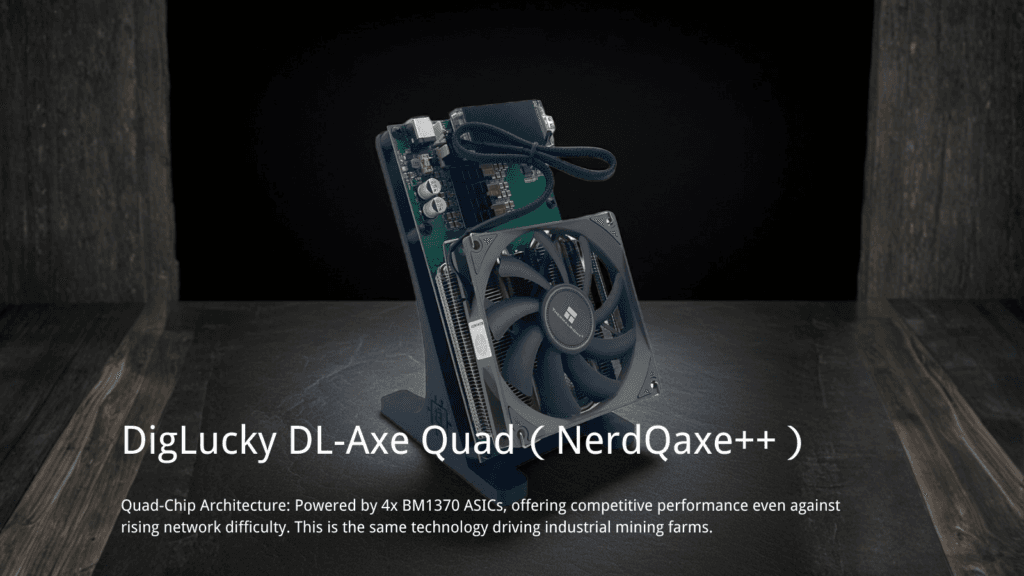
Recently, a common technical bottleneck has emerged across the open-source mining industry. Enthusiasts and prosumers attempting to overclock quad-chip ASIC setups—most notably the popular NerdQaxe++ (equipped with 4x BM1370 chips)—from their factory-rated 4.8 TH/s toward the theoretical 6 TH/s limit, frequently encounter a sudden “Current Protection” warning, resulting in immediate thermal throttling or a hard system reboot.
As a Shenzhen-based factory-direct manufacturer deeply embedded in the open-source hardware supply chain, DigLucky’s R&D team has conducted a comprehensive analysis of this industry-wide phenomenon. Here is the physical logic behind the barrier, alongside our professional engineering guide to safely shattering it.
The Physics of “Current Protection”: Voltage Scaling and Exponential Power Draw
To understand the bottleneck, we must look at semiconductor physics. The BM1370 is an incredibly efficient piece of silicon, typically delivering around 1.2 TH/s per die at a remarkable 15-17 J/TH efficiency. In a standard NerdQaxe++ configuration, four of these chips produce 4.8 TH/s, consuming a highly manageable 76W to 90W.
However, power consumption in ASIC microarchitectures does not scale linearly with clock speed. When you manually increase the frequency and core voltage in an attempt to hit 6 TH/s, the current draw spikes exponentially.
Most standard desktop miners in the industry ship with a basic 12V/10A (120W) power brick. When the overclocked BM1370 chips demand massive transient current spikes, the total system draw effortlessly exceeds 120W. The onboard Texas Instruments TI INA260 power meter detects this abnormal load and immediately triggers the Over-Current Protection (OCP) protocol. This is not a hardware defect; it is a critical failsafe designed to prevent the MOSFETs from incinerating or causing a fire hazard.
Breaking the 4.8 TH/s Ceiling: A Prosumer’s Guide to Hardware Re-Architecture
To bypass this industry-standard limitation and unleash the true potential of the BM1370 silicon, miners must upgrade the underlying electrical and thermodynamic infrastructure.
Step 1: Power Delivery Overhaul (And DigLucky’s Industry-Leading Update)
You cannot fuel a race car with a garden hose. The factory 120W power supply is strictly for default operations.
• The DIY Fix: For extreme overclocking, we advise discarding the stock power brick and integrating an industrial-grade switching power supply, such as The MM-P300 power adapter (200W). This provides an ocean of clean, ripple-free direct current, ensuring the voltage never sags during peak hashing loads.
• The DigLucky Innovation: Recognizing this critical industry pain point, DigLucky is thrilled to announce that all future iterations of our high-performance desktop miners will ship with a custom-engineered 200W power supply as standard. By integrating this massive power overhead right out of the box, we are leading the industry in out-of-the-box overclocking readiness, saving users the cost and hassle of aftermarket PSU hunting.
Step 2: Granular Firmware Tuning via AxeOS
With unlimited power secured, the next step is software optimization. The open-source AxeOS firmware includes hidden developer parameters for precise silicon communication.
• Access the Overclocking Matrix: Navigate to your miner’s web UI. Append ?oc to the end of the settings URL (e.g., http://[IP_ADDRESS]/#/settings?oc). This unlocks the advanced Frequency and Core Voltage fields.
• Incremental Stepping: The BM1370 operates within a voltage window of 0.65V to 1.30V. Never jump straight to maximum values. Increase your frequency by 25MHz increments and bump the voltage by 20mV steps. Allow the system to run for at least 15 minutes between changes to let the capacitors stabilize and ensure the stratum pool connection remains valid without rejected shares.
Step 3: Conquering the Thermal Wall (VRM and Die Cooling)
Joule heating is the final boss of overclocking. While the ASICs get hot, the true point of failure is often the Voltage Regulator Modules (VRMs) on the back of the PCB.
• Targeted VRM Armor: Apply high-conductivity micro-copper heatsinks directly to both the front and rear VRM arrays. This prevents the power delivery phases from hitting their thermal cutoff (usually around 85°C-100°C).
• Phase-Change & Liquid Superiority: For the main ASIC array, swap out standard thermal paste for industrial phase-change materials like PTM7950. If you are chasing absolute silence and maximum stable clocks, air cooling will eventually tap out. This is exactly why we developed the DigLucky NerdQaxe Hydro —an AIO liquid-cooled 4.8 TH/s masterpiece that annihilates thermal throttling entirely.
From Open Source Hobbyist to Enterprise Deployment: The DigLucky Ecosystem
The journey of tuning a NerdQaxe++ is a rite of passage for true Bitcoin geeks. As a factory-direct OEM, DigLucky provides the ultimate playground for these open-source hardware innovations.
However, if you are a B2B procurement decision-maker, a mining farm operator, or looking to deploy commercial hardware without the need for manual tuning, we offer closed-loop, industrial-grade solutions with zero setup friction:
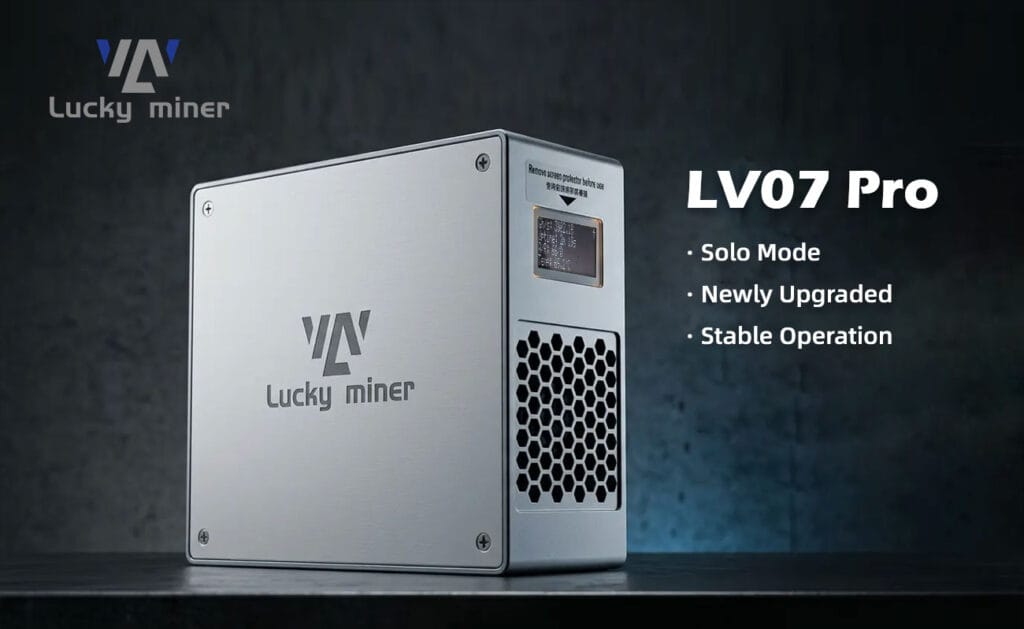
• Commercial Desktop Powerhouse: The Luckyminer LV08. Encased in a sleek aluminum chassis, it delivers a rock-solid 4.2 TH/s at a mere 120W. With a built-in 100~240V AC power supply and silent blower fans, it represents the pinnacle of plug-and-play reliability.
• Mass Deployment & Education: The Luckyminer LV06 (500 GH/s) remains the most cost-effective entry point for branded merchandise, crypto-education networks, and bulk retail.
For the B2C Enthusiast: Ready to push the boundaries of the BM1370? Skip the reseller markup and buy factory-direct. Visit our Factory-Direct Solo Miners for immediate global shipping on the DL-Axe Quad and DL-Axe Hydro.
For B2B and OEM Partners: Do you want to build your own brand of miners? We offer complete white-label customization, custom PCB design, and private molding. Cut out 3 to 4 layers of middlemen and reduce your procurement costs by over 30%. Get your custom B2B/OEM Quote directly from our factory floor today.
Ready to Start Your Project?
Get a factory-direct quote for your B2B project, or shop our B2C store for the best prices.